
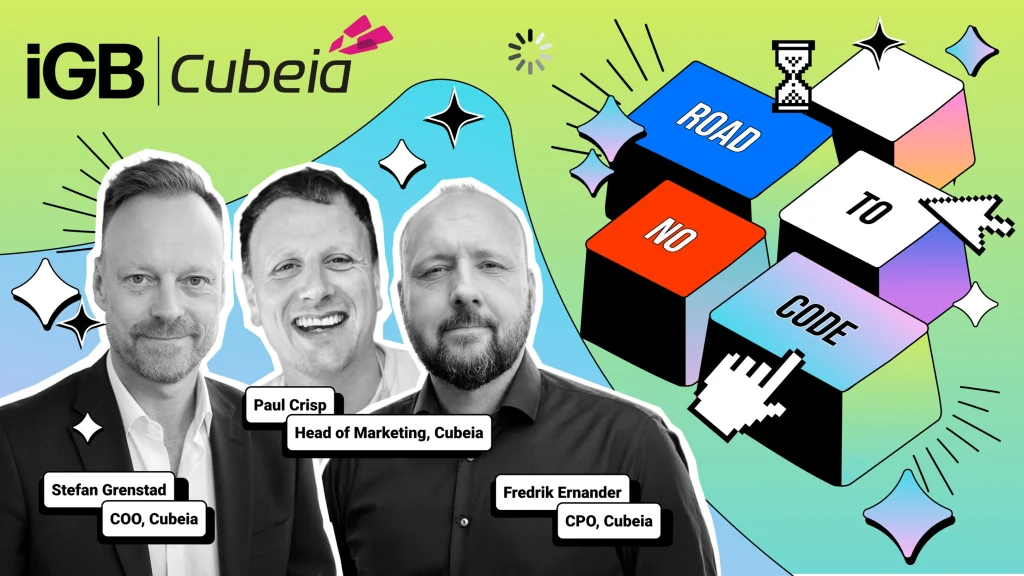
Cubeia has moved completely away from traditional coding. AI-assisted development is now the default way code gets written across the company, and productivity is up 250%. At SBC Lisbon, COO Stefan Grenstad explained how one year rewrote the rules for a platform provider built on speed to market.
Quick facts
| Speaker | Stefan Grenstad, Chief Operating Officer |
| Where | SBC Lisbon 2026 |
| Productivity | Up 250% |
| Feedback loops | From two weeks to the same day |
| Primary LLM | Claude |
| Tech stack | Java platform, React frontend |
| Next step | An agent-operable platform, explored with three operators |
It started in the Jira logs
In November 2025, Cubeia set itself a clear target: every new feature and every new release written by AI by August 2026. The decision came straight from the data.
“We’d noticed a pattern in our Jira logs. AI-mature developers were outperforming their senior colleagues by a huge amount, accounting for 60 per cent of our total output. The reason was that they were utilising AI. With AI multiplying individual output by such an impressive amount, the challenge wasn’t whether to adopt it but how quickly we could make it the default.”
The goal was simple: increase development output without increasing headcount, prototype faster, and shorten feedback loops.
AI by default, not by choice
At Cubeia, AI isn’t an optional add-on that individual developers can choose to skip. Development runs on a structured, agent-based process, with Claude as the primary LLM and a platform built in Java with a React frontend.
The impact shows up in how fast work moves.
“Feedback loops that would take two weeks can now ship, get tested, and be iterated on the same day. Human oversight on quality remains critical.”
Testing is now built into development as it happens, so quality keeps pace with speed. Even the sceptics have come round: one senior developer who was wary of losing control over faster releases is now one of the strongest advocates for the new way of working.
“This is the future, now. But getting the best from it requires a team willing to change how it works.”
From a tooling challenge to an organisational one
With adoption done, the bigger question is how the business itself should evolve.
“We’re now at the stage of organisational change. AI is no longer a tooling challenge but an organisational one. We’ve shifted from writing code quickly to understanding the business problem well enough to direct AI toward the right solution. We have exceptionally strong engineers, and it’s precisely because we’re now so strong technically that our next step is to add more domain and business depth alongside them. It’s a complement to the talent we already have, not a replacement for it.”
“The hard part isn’t adoption; it’s shaping the business: how the company should be structured, who we hire, and how we work with customers once coding is no longer the bottleneck.”
Building a platform AI agents can operate
The next step is making the Cubeia platform agent-operable: built so that AI agents, not just people, can operate it directly, and working cleanly alongside legacy systems. Cubeia is exploring this with three operators right now.
Opening up the platform
Cubeia is also giving operators more freedom over what they build on top of the platform.
“We’re building an SDK that lets customers connect and build their own front end, whatever they want. A lot of mainstream casinos look almost identical today. Giving operators that freedom should unlock far more creativity in how their products look and feel.”
Reporting is getting the AI treatment too.
“You can pull a GGR report and then chat with it directly to dig into the details. That one still needs some polish, but it’s essentially there.”
And there’s more on the way
Cubeia has also just completed the biggest update to Cubeia Poker since it went into production in 2009: a full rebuild on PixiJS, the WebGL-based rendering engine behind some of the web’s most demanding real-time graphics. And there’s a big reveal planned for ICE Barcelona in January 2027.
Talk to us
Want to see what AI-assisted development means for your platform? Get in touch.
Frequently asked questions
- Has Cubeia stopped traditional coding?
Yes. AI tools are now the default way code gets written at Cubeia, built around a structured, agent-based process. All new features and releases are written with AI-assisted code.
- How much has productivity increased?
Cubeia reports a 250% increase in productivity since moving to AI-assisted development. Feedback loops that used to take two weeks can now ship, get tested and be iterated on the same day.
- Which AI model does Cubeia use?
Claude is Cubeia’s primary LLM. The Cubeia platform is built in Java with a React frontend.
- Why did Cubeia make the switch?
Jira data showed that AI-mature developers were producing 60% of total output and outperforming more senior colleagues. Cubeia set a target in November 2025 for all new features and releases to be written by AI by August 2026, to increase output without increasing headcount.
- What does an agent-operable platform mean?
It means building the platform so that AI agents, not just people, can operate it directly. Cubeia is currently exploring this with three operators.
- What else is Cubeia building?
An SDK that lets operators connect and build their own front end, and AI-powered interactive reporting where users can pull a GGR report and chat with it to dig into the details.
- What’s next for Cubeia?
Cubeia recently completed the biggest update to Cubeia Poker since 2009, a full rebuild on PixiJS, and has a major reveal planned for ICE Barcelona in January 2027.