
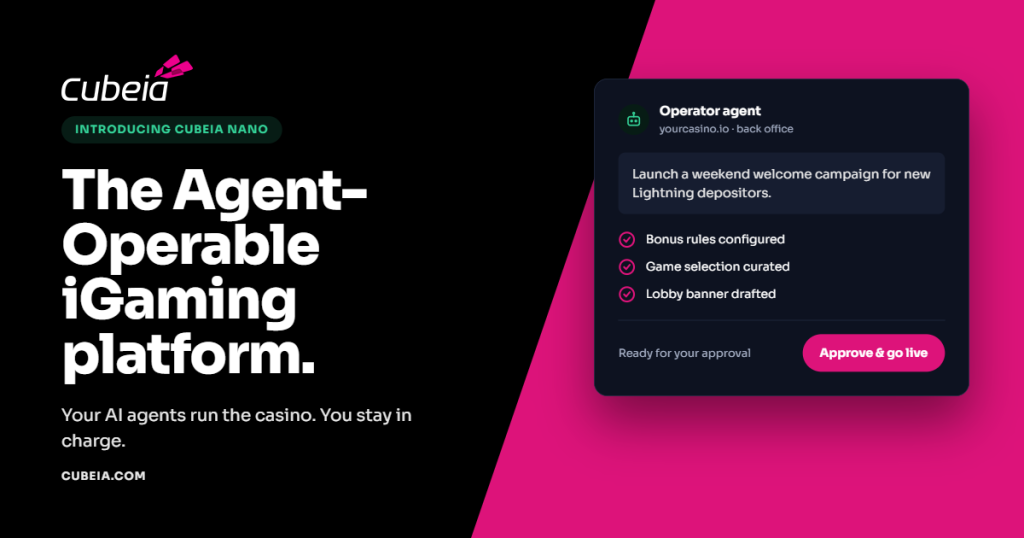
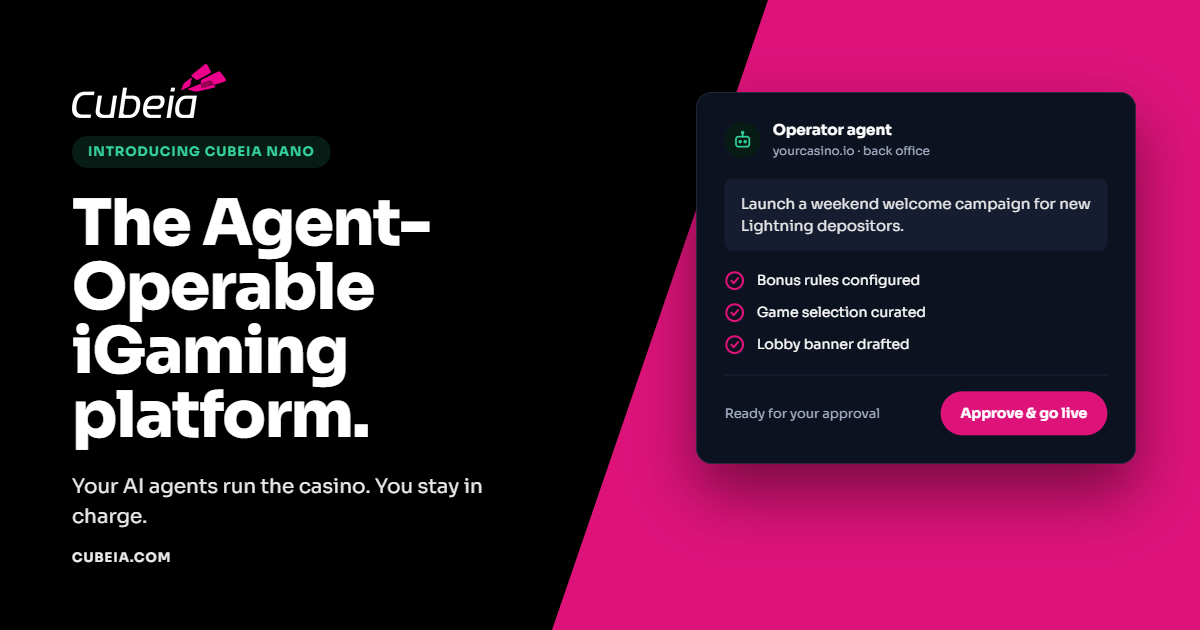
ICE 2027 in Barcelona will see Cubeia showcasing the very first Agent Operable iGaming platform.
Everything starts with an MCP and a data stream so immediate that you query it from wherever you may be. We know that AI can answer all your questions about an operation based on a dataset. The next step is giving it a controlled way to help carry out the work. This is what Cubeia has created, an operation that you can drive from your own AI instance.
Operators already use AI to explore ideas, summarise information and draft content. But a prompt alone cannot complete an operational task. To do that, an AI agent needs a way to work with the systems behind the operation, follow defined permissions and show people what it has done.
That’s the idea behind Cubeia, the Agent-Operable iGaming platform.
From conversation to workflow
During this year’s ICE show, (Stand 2R10) you’ll be able to create your own working casino operation, live in the stand using Agent Operable. Now the AI assistant might answer a question about player activity, but agent can take the next step: gather relevant information from approved systems, carry out the permitted parts of a task and prepare the rest for review.
With Cubeia’s Agent Operable you can use whichever AI infrastructure you are comfortable with, be it ChatGPT, Claude, Gemini, you name it.
For an operator, that could mean connecting workflows across a platform, customer relationship management, payments, reporting and customer support. The agent works through approved interfaces and access rules, while the operator remains in control of what it can see and do.
The goal is not to hand an operation over to AI. It is to make routine, multi-step work easier to coordinate. Do less repetitive stuff to do more rewarding stuff.
Stefan Grenstad, Cubeia COO“The MCP was the first step, Agent Operable moves the concept from beyond the prompt field and into the realm of genuine AI workflows. Freeing the operator up to actually run the operation”
A practical example
Consider a retention team that wants to identify high-value players whose deposits have fallen, while excluding anyone with an unresolved support issue.
An AI agent operating within that workflow could check the permitted player and payment data, review relevant support records, and prepare a suitable customer segment and campaign draft. It could then present its findings and reasoning to the team.
Before any message is sent, a person reviews and approves it. Unless of course you want to set a permission level to skip this step, it’s up to you.
This is the kind of workflow that makes agent operability tangible: several steps brought together, with clear boundaries and a person in control of sensitive actions.
Access needs clear boundaries
For operators to trust an agent, its permissions need to be defined from the start. It should only access the systems and data needed for its assigned task. Actions that affect players, send communications or involve payments should require the right approvals.
A well-designed workflow should also keep a record of what the agent accessed, what it decided and what actions it attempted. That gives teams a way to review its work and improve the process over time.
These controls are part of making the workflow useful. An agent that can act without clear limits is difficult to trust. An agent with defined access, human oversight and an audit trail can be evaluated step by step.