
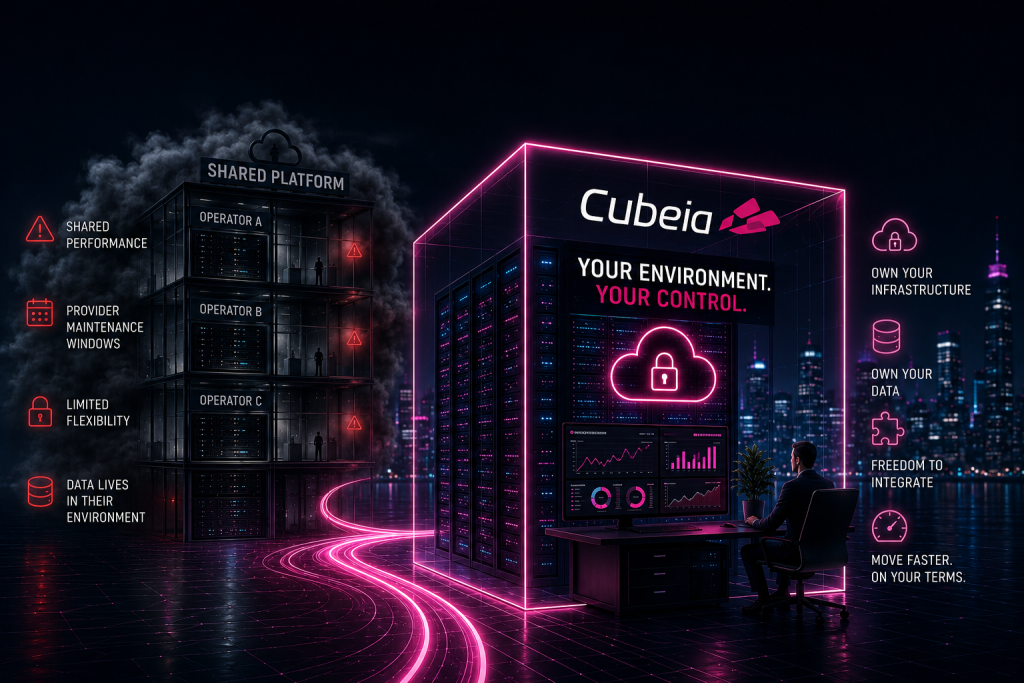
There’s a question most operators don’t think to ask when they’re evaluating platforms: who owns the infrastructure once you go live?
Not the brand. Not the license. The infrastructure. The servers your players hit when they load a game. The database holding your player records. The cloud environment running your payments, your CRM, your back office. When things go wrong, and in iGaming, things always eventually go wrong, whose environment is it?
For most casino operators, the honest answer is: their provider’s.
That’s not a criticism. It’s just how the industry grew up. Shared infrastructure made sense when spinning up a casino required months of engineering and most operators didn’t have the in-house capability to run their own stack. The platform provider took on that complexity, and operators bought access to the result.
The problem is that the industry has moved. Operators are more sophisticated. The regulatory landscape rewards those who can demonstrate real control over their operations. And the hidden costs of not owning your infrastructure have started to show.
What shared infrastructure actually means
When you’re on a shared platform, you’re not the only one on it. That sounds obvious, but consider what it means in practice.
Your platform’s performance is partly a function of what everyone else on that infrastructure is doing. Scheduled maintenance affects you whether you chose that window or not. A compliance requirement introduced for one operator can ripple through to every other client on the stack. And when you want to integrate a new payment provider, a new CRM, or a new content partner, you’re not working with your infrastructure, you’re negotiating access through someone else’s.
None of this makes shared platforms bad. For many operators at certain stages, they’re the right call. But it does mean that growth, at some point, hits a ceiling that isn’t yours to raise.
The data problem nobody talks about
Here’s one that tends to come up late in conversations with operators who are scaling.
Your player data lives in the platform provider’s environment. Not in a cloud account you control, not under your direct access, in theirs. Most agreements give you reporting and exports, but the underlying data sits on infrastructure that belongs to someone else.
This matters for a few reasons.
Regulators in mature markets are increasingly specific about data residency and access. Demonstrating compliance is harder when the infrastructure isn’t yours. As operators expand into new jurisdictions, a trend that’s defining 2025 and 2026, the ability to show a regulator exactly where player data lives, and prove that you control it, is becoming a genuine licensing consideration, not just a best-practice checkbox.
It also matters commercially. The operators who are winning on retention in 2026 are doing so with sophisticated, real-time player intelligence. They’re not waiting for an export. They’re running queries. That’s only possible if you have genuine access to your own data, not a view into someone else’s.
What the alternative looks like
The shift we’ve seen in the last two to three years is toward a different model. Instead of accessing a shared platform, operators deploy into their own cloud environment. The platform provider configures and supports it, but the infrastructure sits in the operator’s account, under the operator’s control.
This is what we built Cubeia Nano around.
When an operator launches on Nano, they’re not sharing infrastructure with anyone else. Their cloud environment is theirs. Their player data lives in their account. If they want to swap a payment provider, integrate a new analytics tool, or change how their back-office works, they make that call. We handle the technical delivery; they own the outcome.
The practical result is that operators can move faster, not slower, as they grow. There’s no queue for infrastructure changes. No dependency on another operator’s maintenance schedule. No negotiation about what you’re allowed to integrate.
Legendz.io went from signed agreement to live casino in under 12 weeks on this model. More importantly, they launched with everything configured to their spec, payments, CRM, affiliate tooling, infrastructure, not to a standard template. Speed didn’t come at the expense of control. They had both because the platform was theirs.
The question worth asking before you sign
When operators evaluate platforms in 2026, most of the conversation is about games, payment rails, and time-to-market. Those are the right things to evaluate.
But the infrastructure question is worth adding to the list.
When the platform goes down, whose SLA are you holding? When a regulator asks to see your data governance, what can you actually demonstrate? When you want to build something that doesn’t exist on the platform yet, who decides if it gets built?
The answers tell you more about your long-term runway than any feature list.
Platform access is a product. Platform ownership is a different thing entirely. The distinction matters more than most operators realize until the moment it really matters.
Cubeia builds iGaming platform technology for operators who want to own their infrastructure, not just use it. The Nano Platform deploys into the operator’s own cloud environment, with the full stack configured and supported by Cubeia. cubeia.com/platform